
Shinjuku has the densest cluster of skyscrapers in Tokyo, which means the gap between a room on the 8th floor and a room on the 38th floor is the difference between staring at a concrete wall and watching the entire city light up below you. Get the floor right and you get one of the great urban views on earth, a sea of neon and office towers stretching all the way to the horizon, with Mount Fuji ghosting the skyline on a clear winter morning. The hotels below were picked specifically for their view credentials, from floor-to-ceiling panoramic windows to open-air baths with the Tokyo skyline as a backdrop.
Table of Contents
Shinjuku Hotels

| 1. Bellustar Tokyo, A Pan Pacific Hotel Most Luxurious Rating: ⭐⭐⭐⭐⭐ Location: 7-min walk to JR Shinjuku Station East Exit Guest Reviews: 7-metre windows, floor-to-ceiling panoramas, Mount Fuji visible on clear days, top-floor French restaurant Best Room: Junior Corner Suite Price: From USD $600 – $1,200 per night |

| 2. Park Hyatt Tokyo Best View Rating: ⭐⭐⭐⭐⭐ Location: 15-min walk to JR Shinjuku Station, 3-min walk to Tochomae Station Guest Reviews: 52nd-floor New York Grill, 47th-floor pool, Hokkaido wood panelling, Mount Fuji visible above 40th floor Best Room: Deluxe King Suite Price: From USD $835 – $1,100 per night |

| 3. Hotel Groove Shinjuku, A ParkRoyal Hotel Best for Couples Rating: ⭐⭐⭐⭐ Location: 8-min walk to JR Shinjuku Station, 5-min walk to Seibu-Shinjuku Station Guest Reviews: Floor-to-ceiling windows, Tokyo Skytree visible, laundry on 20th floor, JAM17 bar on 17th Best Room: Premier Suite Price: From USD $250 – $450 per night |

| 4. Keio Plaza Hotel Tokyo Premier Grand Best for Families Rating: ⭐⭐⭐⭐⭐ Location: 10-min walk to JR Shinjuku Station, 5-min walk to Tochomae Station Guest Reviews: 45th-floor Club Lounge at 160m, Government Building light show from rooms, Mount Fuji, breakfast included Best Room: Premier Grand King Price: From USD $220 – $410 per night |

| 5. Odakyu Hotel Century Southern Tower Best Location Rating: ⭐⭐⭐⭐ Location: 3-min walk to Shinjuku Station New South Exit Guest Reviews: Lobby on 20th floor, corner rooms with wraparound views, larger than Tokyo-average rooms, Shiseido toiletries Best Room: Panoramic King Price: From USD $165 – $300 per night |

| 6. Hilton Tokyo Rating: ⭐⭐⭐⭐⭐ Location: 4-min walk to Nishi-Shinjuku Station, 10-min walk to JR Shinjuku Station Guest Reviews: 37th-floor Executive Lounge panorama, Mount Fuji from upper west rooms, indoor pool, outdoor tennis courts Best Room: Executive Tower Suite Price: From USD $240 – $400 per night |
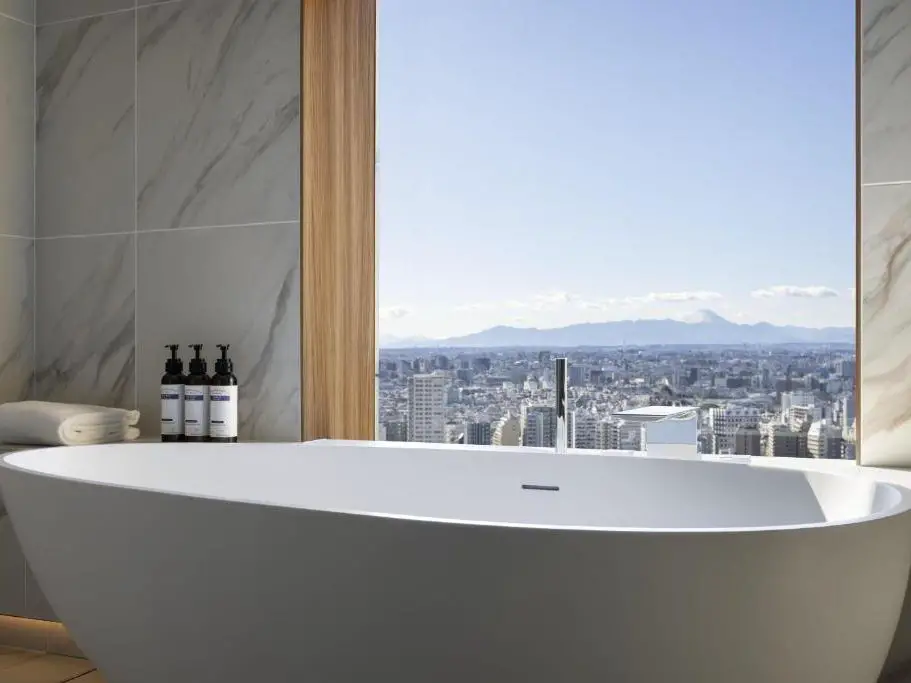
| 7. Hyatt Regency Tokyo Best Bathtub View Rating: ⭐⭐⭐⭐ Location: 3-min walk to Tochomae Station, 10-min walk to JR Shinjuku Station Guest Reviews: Direct underground link to Tochomae Station, corner studios with Mt Fuji view, Joule Spa, airport limousine stop Best Room: Regency Suite Price: From USD $175 – $350 per night |

| 8. Kimpton Shinjuku Tokyo Most Unique Stay Rating: ⭐⭐⭐⭐⭐ Location: 5-min walk to Tochomae Station, 12-min walk to JR Shinjuku Station Guest Reviews: Rooftop bar 86 on 17th floor, remote-controlled blackout shades, complimentary daily social hour, loaner bikes Best Room: Top Floor King Suite Price: From USD $300 – $500 per night |
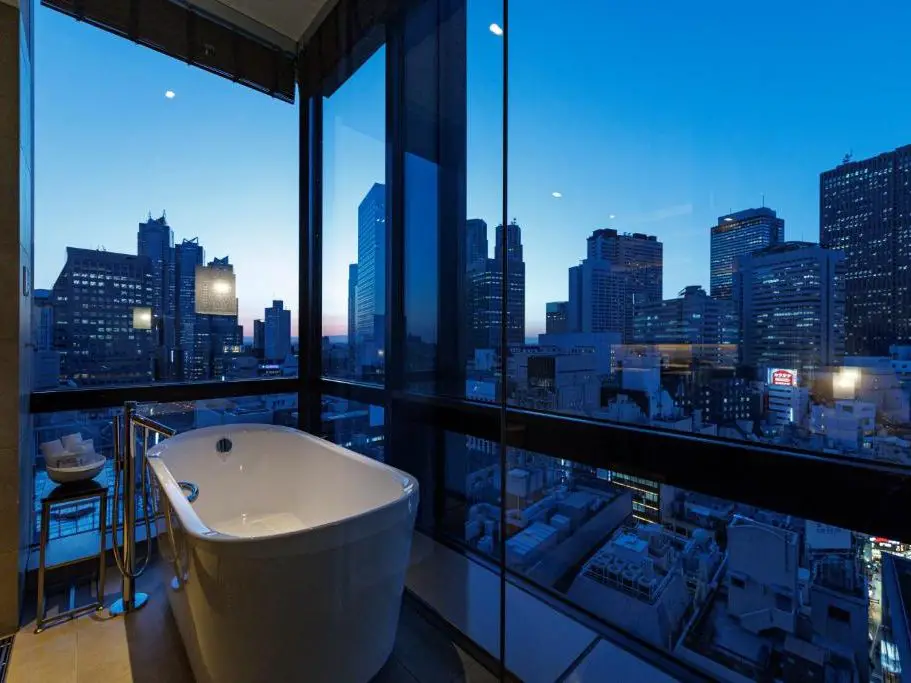
| 9. JR Kyushu Hotel Blossom Shinjuku Rating: ⭐⭐⭐⭐ Location: 3-min walk to Shinjuku Station South Exit Guest Reviews: 15th–16th floor bathtub facing Nishi-Shinjuku skyline, Simmons mattresses, air purifier each room, Umaya Kyushu restaurant Best Room: Premium Twin with View from Bathroom (Floor 15–16) Price: From USD $160 – $280 per night |
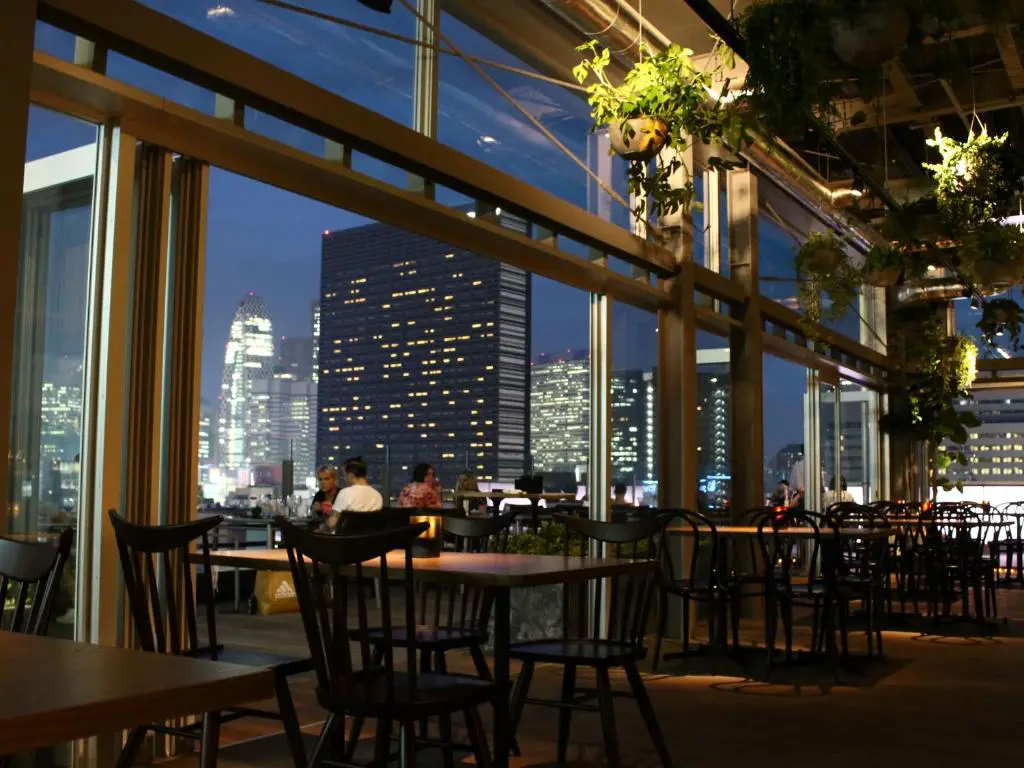
| 10. Shinjuku Granbell Hotel Best Value Rating: ⭐⭐⭐⭐ Location: 4-min walk to Higashi-Shinjuku Station, 10-min walk to JR Shinjuku Station East Exit Guest Reviews: Rooftop bar on 13th floor, floor-to-ceiling windows with Simmons beds, loft rooms on 12th floor Best Room: Villa Suite Price: From USD $95 – $180 per night |
West Shinjuku vs East Shinjuku: How Location Changes Your View
The two halves of Shinjuku look nothing like each other from a hotel window, and the difference matters when you’re choosing where to sleep.
- West Shinjuku — where Park Hyatt Tokyo, Keio Plaza Hotel Tokyo Premier Grand, Hilton Tokyo, Hyatt Regency Tokyo, and Kimpton Shinjuku Tokyo all sit — is Tokyo’s skyscraper district. The view here is architectural: ranks of glass towers, the twin spires of the Tokyo Metropolitan Government Building, and on clear winter mornings, Mount Fuji floating above the horizon to the southwest. It’s quieter at street level, which makes the contrast between the calm below and the scale above even more striking at night.
- East Shinjuku and Kabukicho — home to Bellustar Tokyo, Hotel Groove Shinjuku, Shinjuku Granbell Hotel, and JR Kyushu Hotel Blossom Shinjuku — delivers a different picture entirely. From height, you’re looking down on a dense neon grid: pachinko signs, entertainment towers, the glow of a thousand restaurants packed into narrow streets. It’s louder, more chaotic, and genuinely spectacular after dark in a way that the quieter west side isn’t.
- Odakyu Hotel Century Southern Tower sits right on the dividing line at the south exit, with views that take in both sides depending on which direction your room faces — one of the reasons the Panoramic King there is worth requesting specifically.
Neither view is better. They’re just different cities. Knowing which one you want before you book saves the disappointment of arriving on the wrong side of the station.
How to Actually Secure the View You’re Paying For
“City view” as a room category covers a wide range of actual experiences. A few steps at booking make the difference between a partial outlook into a neighbouring tower and the panorama you came for.
- Choose the right room type, not just the right hotel. At Bellustar Tokyo and Park Hyatt Tokyo, every room faces outward by design — there’s no bad side. At most other hotels, view rooms are a specific category. At JR Kyushu Hotel Blossom Shinjuku, the bathtub-faces-skyline experience only exists in the Premium Twin on floors 15–16. That room type must be selected at booking, not requested at check-in.
- Add a direction request to your reservation. West-facing rooms at Hilton Tokyo and Hyatt Regency Tokyo open up Mount Fuji sightlines; east-facing rooms at the same hotels look into office towers. Tokyo hotel staff read reservation notes carefully. “High floor, west-facing if possible” costs nothing to ask and frequently works.
- Request a high floor at check-in if you didn’t book one. Weeknights and the slower months — January, February, June — give you the best odds of a complimentary floor upgrade on arrival. Ask politely; it works more often than most visitors expect.
- Use loyalty status for room assignment priority. Members at World of Hyatt (Park Hyatt Tokyo, Hyatt Regency Tokyo), IHG One Rewards (Kimpton Shinjuku Tokyo), and Hilton Honors (Hilton Tokyo) are typically prioritised for better room assignments over non-members at the same rate. Enrolling before booking costs nothing.
- Consider whether the view-room premium is worth it. At Keio Plaza Hotel Tokyo Premier Grand, the gap between a standard room and a Premier Grand high-floor room is smaller than it looks relative to the total cost of a Tokyo trip. The difference in what you actually see is not small.
When Mt Fuji Is Visible from Shinjuku (And When It Isn’t)
Several hotels on this list market Mount Fuji views, and the reality is more conditional than the photos suggest. Understanding the actual odds helps you decide whether to pay the premium for a west-facing room or adjust your expectations accordingly.
- Winter is the only reliable season. December through February gives you the best chance — cold, dry air and low humidity keep the atmosphere clear. On a good winter morning from the upper floors of Park Hyatt Tokyo or Keio Plaza Hotel Tokyo Premier Grand, Fuji sits cleanly on the horizon above the western skyline. From March onward, haze, humidity, and eventually typhoon season make sightings increasingly rare.
- Morning beats evening. Fuji tends to disappear into haze as the day warms up. The best window is the first two hours after sunrise. Guests at Hyatt Regency Tokyo and Hilton Tokyo who specifically request west-facing upper-floor rooms report the most consistent sightings at this time.
- You need to be above the 20th floor. Below that, the foreground buildings of Nishi-Shinjuku block the western horizon entirely. The Tokyo Metropolitan Government Building in particular cuts off lower sightlines. At Keio Plaza Hotel Tokyo Premier Grand, the 45th-floor Club Lounge is the most reliable spot on this list for a clear Fuji view.
- East-facing rooms won’t see it at all. Hotels in Kabukicho — Bellustar Tokyo, Hotel Groove Shinjuku, Shinjuku Granbell Hotel — face east or northeast. The views are spectacular at night, but Fuji is a west-southwest landmark and simply isn’t in the picture from that side of Shinjuku.
- Treat it as a bonus, not a guarantee. Even in peak winter, cloud cover blocks Fuji more days than not. The Tokyo skyline at night from any of these hotels is reliable and extraordinary regardless of season. Fuji is the exception, not the baseline.
The View From the 10th Floor vs the 40th Floor: What You’re Actually Getting
The difference between a 10th-floor room and a 40th-floor room in Shinjuku isn’t just a matter of degree — the view changes in kind. Here’s what each altitude band actually delivers.
- Below the 15th floor — partial views, significant obstruction. You’re still above street level, but neighbouring buildings fill the foreground. At this height in West Shinjuku, the Tokyo Metropolitan Government Building blocks large sections of the western horizon. Worth considering only if the price gap is substantial and the view isn’t the primary reason you’re booking.
- 15th to 25th floor — solid city views, no longer blocked. The foreground clears at this height and the scale of Shinjuku starts to become apparent. This is the sweet spot at Odakyu Hotel Century Southern Tower (lobby starts at the 19th floor, so all rooms are already here), JR Kyushu Hotel Blossom Shinjuku (the premium view rooms sit on floors 15–16), and Hyatt Regency Tokyo (corner studios on the 24th floor are the highlight). Good views, no need to pay a sky-high premium.
- 25th to 38th floor — the panorama opens up properly. The density of the city below starts to feel cinematic rather than claustrophobic. Hotel Groove Shinjuku operates across floors 20–38, and guests consistently note that rooms in the upper third of that range are where the floor-to-ceiling windows really earn their reputation. Hilton Tokyo‘s Executive Lounge sits on the 37th floor and gives a genuine sense of floating above the district.
- 39th floor and above — a different experience entirely. At this altitude the city becomes a map. Bellustar Tokyo starts at the 39th floor — the lowest room is already above almost every other building in the area. Park Hyatt Tokyo occupies floors 39–52 of Shinjuku Park Tower, and above the 40th floor the horizon extends far enough west to include Fuji on clear days. Rooms at this height cost more for good reason.
- The Tokyo Metropolitan Government Building as a reference point. Its observation decks sit at 202 metres — roughly equivalent to the 45th floor of a standard building. If you’re staying at Keio Plaza Hotel Tokyo Premier Grand and accessing the Club Lounge on the 45th floor, you’re looking out at roughly that altitude. It’s a useful benchmark for calibrating what “high” actually means in this part of Tokyo.
The Best Time of Day (and Year) to Be Up High in Shinjuku
Shinjuku looks different at every hour, and knowing when to be at your window — or at a rooftop bar — is worth thinking about before you arrive.
- Sunrise to mid-morning — the clearest air of the day. Atmospheric haze builds as Tokyo warms up. If you’re at Park Hyatt Tokyo or Keio Plaza Hotel Tokyo Premier Grand and hoping for a Fuji sighting, this is your window. The low-angle light also catches the glass towers of Nishi-Shinjuku in a way that no other time of day replicates.
- Golden hour — the transition worth staying in for. The hour before sunset is when West Shinjuku earns its reputation. The towers catch the light from the west, the streets below are still active, and the sky behind Fuji (on clear days) turns the kind of colours that make the view-room premium feel entirely justified. Hilton Tokyo and Hyatt Regency Tokyo west-facing rooms are particularly well-positioned for this.
- After dark — the real reason most people book here. Tokyo’s night skyline from Shinjuku is one of the great urban views on the planet. The neon density of Kabukicho, the illuminated government towers, the NTT Docomo Yoyogi Building lit up to the south — it all comes together between 8pm and midnight. The rooftop bar at Kimpton Shinjuku Tokyo and the terrace at Shinjuku Granbell Hotel are both oriented for exactly this. Rooms at Bellustar Tokyo and Hotel Groove Shinjuku face east over Kabukicho, which at night is the more spectacular direction anyway.
- The Tokyo Metropolitan Government Building light show — a specific reason to look west from 8pm. The building runs projection mapping on its facade most evenings. Guests at Keio Plaza Hotel Tokyo Premier Grand with rooms facing the government building report this as one of the highlights of their stay — it’s visible from the upper floors and entirely free.
- Winter vs summer — opposite strengths. Winter (December to February) wins on clarity: sharp air, Fuji sightings, and the city lit up against cold dark skies. Summer loses on haze but gains on energy — the streets below are busier, the neon brighter against the humid air, and the rooftop bars at Hotel Groove Shinjuku and Shinjuku Granbell Hotel come into their own. Autumn (October and November) is the best overall compromise: clear enough for good views, warm enough to use outdoor terraces.
How to Choose the Right Hotel for Your Budget
The view quality across this list varies more by floor height and room type than by price tier — but price does determine which buildings you can access, and some altitude levels are simply not available below certain budgets.
- Ultra-luxury: $500 and above per night – Bellustar Tokyo and Park Hyatt Tokyo occupy a tier of their own. Both sit above the 39th floor by design, meaning the view is structural rather than a feature you have to request. Bellustar Tokyo is the newer property with the more contemporary design; Park Hyatt Tokyo carries the cultural weight of Lost in Translation and the 52nd-floor New York Grill. The choice between them comes down to whether you want Kabukicho neon to the east or the Nishi-Shinjuku skyline and Fuji to the west.
- Premium: $200–$500 per night – The most competitive tier on this list. Kimpton Shinjuku Tokyo delivers boutique personality and the rooftop bar at a price point below the ultra-luxury options. Keio Plaza Hotel Tokyo Premier Grand offers the best Club Lounge view on the list at 160 metres, with breakfast included on Premier Grand floors. Hotel Groove Shinjuku is the strongest value in this band — floor-to-ceiling windows, rooms across floors 20–38, and a genuinely contemporary feel at rates well below the five-star properties. Hilton Tokyo suits points travelers and those who want a reliable full-service property with a known commodity.
- Mid-range: $150–$250 per night – Odakyu Hotel Century Southern Tower is the standout here — lobby at the 19th floor, rooms larger than the Tokyo average, Panoramic King with wraparound views, and three minutes from Shinjuku Station. Hyatt Regency Tokyo offers spacious rooms and direct subway access at rates that regularly undercut its star rating, particularly for World of Hyatt members. JR Kyushu Hotel Blossom Shinjuku earns its place specifically on the Premium Twin floors 15–16 — a deep-soak bathtub facing the skyline at this price point is hard to beat.
- Value: under $150 per night – Shinjuku Granbell Hotel is the only genuine view option at this end of the list. The rooftop bar on the 13th floor and loft rooms on the 12th deliver a real Kabukicho night outlook at a fraction of the cost of the properties above it. Rooms are compact and the building isn’t tall, but for the price the view credentials are legitimate.
FAQs
1. Do all rooms at these hotels have city views, or do I need to request one specifically?
Only Bellustar Tokyo and Park Hyatt Tokyo are designed so that every room faces outward. At all other hotels on this list, city view rooms are a specific category or a floor-dependent feature. Always select a view room type explicitly at booking and add a direction preference in the reservation notes.
2. Which hotels on this list have the best chance of a Mount Fuji view?
Park Hyatt Tokyo above the 40th floor and Keio Plaza Hotel Tokyo Premier Grand from the 45th-floor Club Lounge give you the most consistent angle. Hilton Tokyo and Hyatt Regency Tokyo on upper west-facing floors are also reliable in winter. December through February is the only season where sightings are regular — summer is near-zero visibility for Fuji regardless of floor height.
3. Is the view noticeably better if I pay for a higher floor?
Yes, meaningfully so up to around the 25th floor, where most obstruction from neighbouring buildings disappears. Above the 38th floor the experience changes category entirely — the city becomes a panorama rather than a collection of nearby buildings. The jump from a 15th-floor room to a 40th-floor room at the same hotel is not a marginal upgrade.
4. Which hotel is best for night views specifically?
Bellustar Tokyo and Hotel Groove Shinjuku face east over Kabukicho, which is the more spectacular direction after dark. The rooftop bar at Kimpton Shinjuku Tokyo and the 13th-floor terrace at Shinjuku Granbell Hotel are both well-positioned for the Shinjuku neon grid at night. For the West Shinjuku skyline lit up after dark, Park Hyatt Tokyo and Keio Plaza Hotel Tokyo Premier Grand are the strongest options.
5. How far are these hotels from Shinjuku Station, and does location affect the view?
Walking times range from 3 minutes (Odakyu Hotel Century Southern Tower, JR Kyushu Hotel Blossom Shinjuku) to 15 minutes (Park Hyatt Tokyo). Location affects view character significantly — west-side hotels see the skyscraper panorama and Fuji; east-side hotels see the neon entertainment district. Neither is superior, but they’re genuinely different visual experiences.
6. Are the rooftop bars at these hotels open to non-guests?
Kimpton Shinjuku Tokyo‘s rooftop bar 86 and Shinjuku Granbell Hotel‘s 13th-floor terrace both welcome non-guests, though reservations are recommended for the Kimpton. Hotel Groove Shinjuku‘s JAM17 bar on the 17th floor is also open to non-guests. The upper-floor lounges at Keio Plaza Hotel Tokyo Premier Grand, Hilton Tokyo, and Hyatt Regency Tokyo are reserved for guests with relevant room categories or loyalty status.
7. When is the best time of year to book for the clearest views?
December through February for daytime clarity and Fuji sightings. October and November for the best balance — clear air, comfortable temperatures, and outdoor terraces still usable. June is the worst month for views due to the rainy season, but hotel rates drop noticeably and the night skyline remains spectacular regardless of daytime haze.
8. Is it worth paying the premium for a suite at one of these hotels just for the view?
At Bellustar Tokyo and Park Hyatt Tokyo, suites add meaningful floor height and window size on top of already exceptional base rooms — the premium is defensible. At mid-range hotels like Odakyu Hotel Century Southern Tower and Hyatt Regency Tokyo, the corner room or panoramic category delivers most of the view benefit at a fraction of the suite price. Suites at those properties add space and amenities more than they add view quality.