
Kruger’s private reserves have raised the bar so high that “sleeping in a tent” now means private plunge pools, butler service, and three-course dinners under the stars. The camps here sit inside or directly on the borders of some of Africa’s richest Big Five territory, so wildlife doesn’t wait for a game drive — elephants drink at waterholes below your deck, and lions call through the dark while you’re still at dinner. Prices range from genuinely accessible to full splurge, and the style of each camp varies enough that choosing the right one makes a real difference to your stay. Here are the best luxury tented camps in Kruger National Park, with the practical detail you need to book confidently.
Table of Contents
Kruger National Park Luxury Camps

| 1. Saseka Tented Camp Most Iconic Tent Design Rating: ⭐⭐⭐⭐⭐ Location: 30-minute drive from Hoedspruit Eastgate Airport, Thornybush Nature Reserve Guest Reviews: Riverbed wildlife views from private deck, outstanding guide and tracker team, exceptional food, immersive Big Five sightings Best Room: Luxury Tent, Private Pool Price: From USD $2,850 – $3,100 per night (fully inclusive: all meals, drinks, and twice-daily game drives) |

| 2. Kapama Buffalo Camp Best Treetop Tented Suites Rating: ⭐⭐⭐⭐⭐ Location: 20-minute drive from Hoedspruit Eastgate Airport, Kapama Private Game Reserve Guest Reviews: Tents elevated high in riverine trees, exceptional Big Five sightings including lion hunts, boma dinners under open sky, outstanding ranger and tracker teams Best Room: Luxury Tent (Buffalo Camp) Price: From USD $1,600 – $1,800 per night (fully inclusive: all meals, selected drinks, and twice-daily game drives) |

| 3. Parsons Hilltop Safari Camp Best Private Jacuzzi Tent Rating: ⭐⭐⭐⭐ Location: 25-minute drive from Hoedspruit Eastgate Airport, Balule Game Reserve Guest Reviews: Night-lit waterhole viewed from private deck, outdoor jacuzzi on luxury tent, Drakensberg mountain views, knowledgeable guides with Big Five focus Best Room: Luxury Safari Tent Price: From USD $495 – $550 per night (inclusive of all meals and twice-daily game drives) |

| 4. Simbavati Hilltop Lodge Best Hilltop Views Rating: ⭐⭐⭐⭐ Location: 35-minute drive from Hoedspruit Eastgate Airport, Timbavati Private Nature Reserve Guest Reviews: Panoramic Drakensberg and river views from private deck, elephants walking through camp, Big Five game drives with Shangaan trackers, 360-degree hilltop infinity bar Best Room: Luxury Tent Price: From USD $2,525 – $2,780 per night (fully inclusive: all meals, selected drinks, and twice-daily game drives) |

| 5. Hamiltons Tented Camp Best Colonial Safari Style Rating: ⭐⭐⭐⭐⭐ Location: 40-minute drive from Hoedspruit Eastgate Airport, Mluwati Concession, Kruger National Park Guest Reviews: Colonial teak floors and slipper baths, river-view private deck with plunge pool, butler service, strong Big Cat sightings in concession Best Room: Tented Suite Price: From USD $950 – $1,650 per night (fully inclusive: all meals, selected drinks, and twice-daily game drives) |

| 6. Pafuri Tented Camp Best for Birding Safaris Rating: ⭐⭐⭐⭐ Location: 3-hour drive from Phalaborwa Airport, Makuleke Concession, northern Kruger National Park Guest Reviews: Elephants in river directly below tent deck, world-class birding with 450-plus species, fever tree forest walks, knowledgeable guides Best Room: Tented Suite Price: From USD $1,050 – $1,200 per night (fully inclusive: all meals, game drives, and guided walks) |

| 7. Honeyguide Tented Safari Camps – Mantobeni Best Value Luxury Tent Rating: ⭐⭐⭐⭐ Location: 30-minute drive from Hoedspruit Eastgate Airport, Manyeleti Private Game Reserve Guest Reviews: Unfenced camp with elephants at the pool, cheetah and lion cub sightings on drives, sunken concrete bath in en-suite, South African wine cellar Best Room: Luxury Tent Price: From USD $770 – $990 per night (fully inclusive: all meals and twice-daily game drives) |

| 8. Shindzela Tented Camp Best Eco Safari Experience Rating: ⭐⭐⭐⭐ Location: 1-hour drive from Hoedspruit Eastgate Airport, Timbavati Private Nature Reserve Guest Reviews: Solar-powered eco camp with waterhole views, honey badger sightings, Amarula bread pudding at dinner, walking safaris with armed rangers Best Room: Safari Tent Price: From USD $670 – $750 per night (fully inclusive: all meals and twice-daily game drives) |

| 9. Umkumbe Bush Lodge Rating: ⭐⭐⭐⭐ Location: 25-minute drive from Skukuza Airport, Sabie Game Reserve, Sabi Sand Guest Reviews: Treehouse deck overlooking drainage line, leopard tracking at night, outdoor shower on raised platform, Big Five within first two drives Best Room: Superior Tent Price: From USD $760 – $850 per night (inclusive of all meals and twice-daily game drives) |
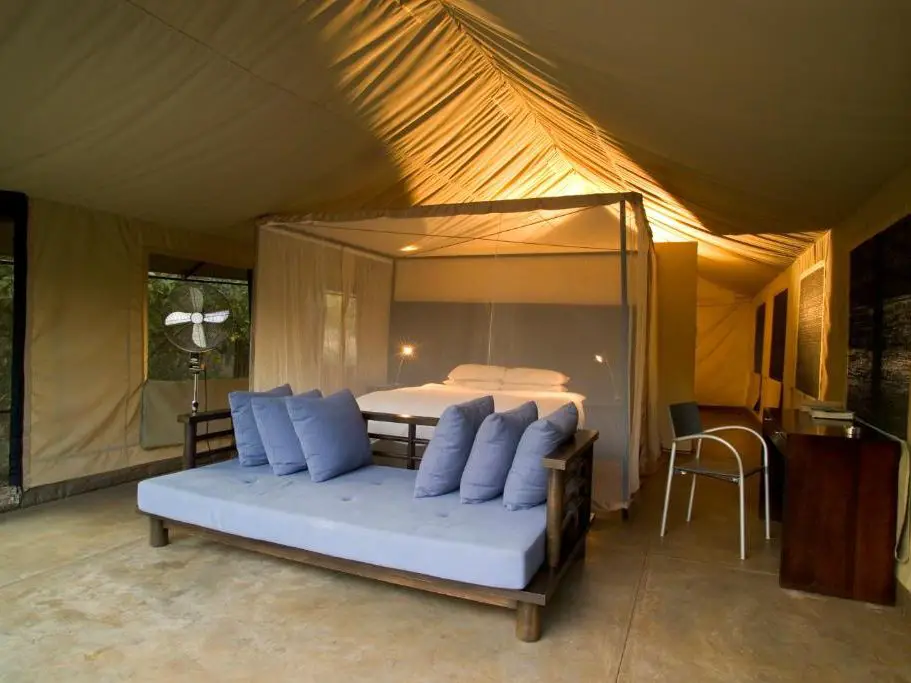
| 10. Honeyguide Tented Safari Camp – Khoka Moya Best for Families Rating: ⭐⭐⭐⭐ Location: 30-minute drive from Hoedspruit Eastgate Airport, Manyeleti Private Game Reserve Guest Reviews: Unfenced riverbed setting with lions audible at night, junior tracking for children, four-poster beds in 60sqm tents, Big Five off-road game drives Best Room: Luxury Tent Price: From USD $435 – $550 per night (fully inclusive: all meals and twice-daily game drives) |
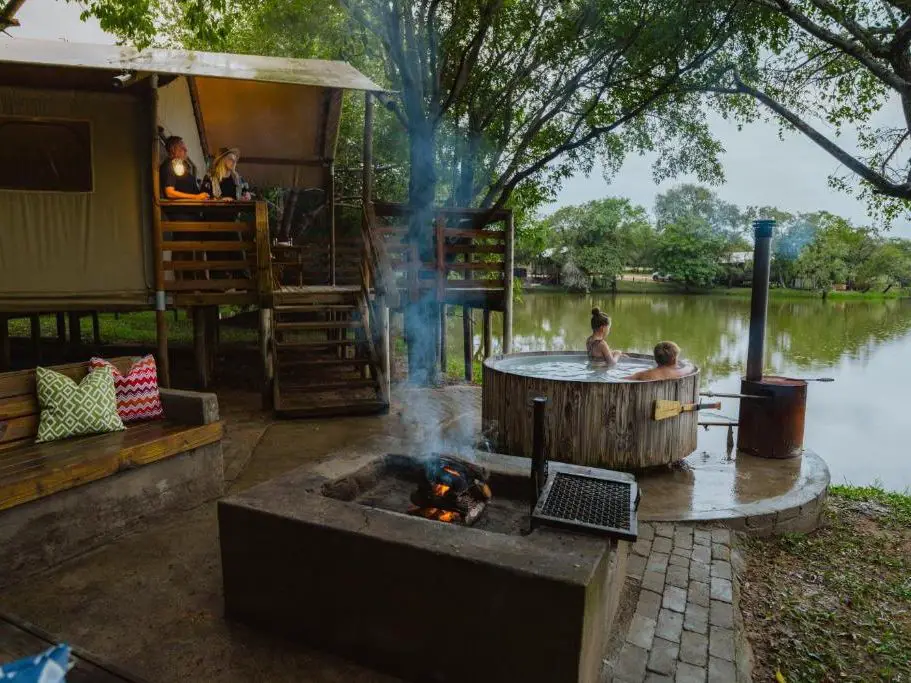
| 11. AfriCamps at Hoedspruit Best for Self-Drive Glampers Rating: ⭐⭐⭐⭐ Location: 15-minute drive from Hoedspruit town, Klaserie Private Nature Reserve border Guest Reviews: Wood-fired hot tub overlooking dam, zebra and nyala on the water’s edge, fully equipped kitchen and indoor fireplace, catch-and-release dam fishing Best Room: Luxury Tent, 2 Bedrooms Price: From USD $80 – $105 per night (self-catering; safaris and meals not included) |
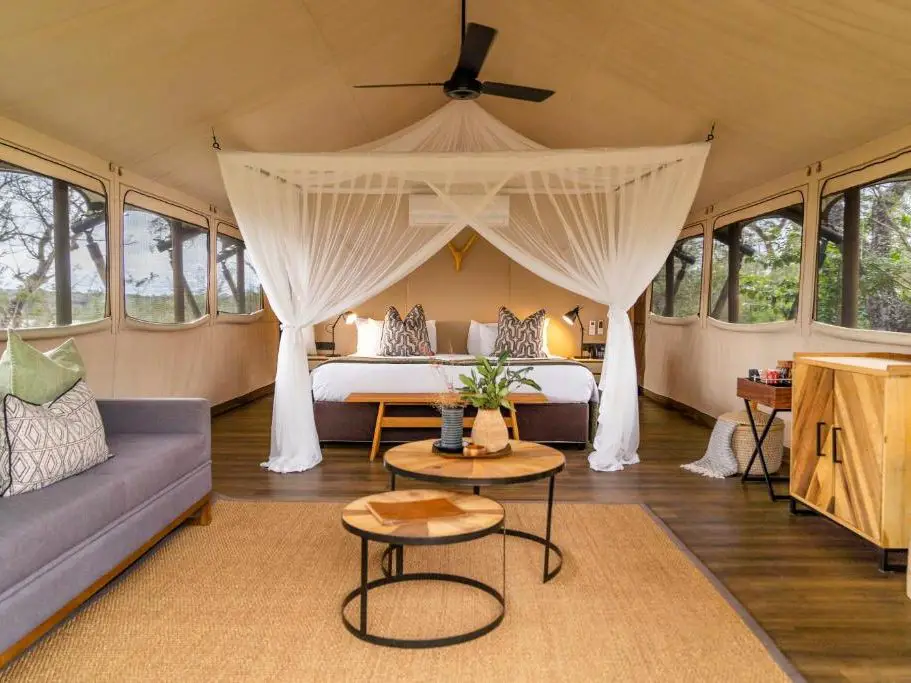
| 12. Mdluli Safari Lodge Only Community-Owned Camp in Kruger Rating: ⭐⭐⭐⭐ Location: 21-minute drive from Numbi Gate, south-western Kruger National Park Guest Reviews: Infinity pool with direct Kruger bush views, elephants visiting the lodge, boma dinners under open sky, community-owned land reform story Best Room: Luxury Tent Price: From USD $390 – $655 per night (includes breakfast and dinner; game drives at extra cost) |
Which Private Reserve Suits Your Safari Goals
The camps above sit across six private reserves and one national park concession, and where you stay shapes the trip as much as which camp you pick.
- Timbavati — One of the largest and least-crowded private reserves in the Greater Kruger, sharing an open boundary with the national park. Shindzela and Simbavati Hilltop Lodge both sit here. Traversing areas are generous and the reserve is known for strong elephant and lion sightings and, historically, the occasional white lion. Roads can be rough — budget an hour from Hoedspruit Eastgate.
- Thornybush — A tightly managed, Big Five reserve directly adjacent to Timbavati. Saseka Tented Camp is here. Smaller traversing area than Timbavati but high animal density and exceptional guiding. Particularly good for leopard and rhino.
- Manyeleti — Sandwiched between Kruger, Sabi Sand, and Timbavati, this is where both Honeyguide camps sit. It sees a fraction of Sabi Sand’s visitor numbers but draws on the same wildlife corridor. One of the best-value options in the Greater Kruger for the quality of sightings you get.
- Kapama — A compact private reserve close to Hoedspruit, home to Kapama Buffalo Camp. Known for reliable Big Five, with its own elephant sanctuary nearby. Good choice for first-timers who want a short transfer and a structured, well-run operation.
- Balule and Klaserie — These open, unfenced reserves share the Olifants River corridor. Parsons Hilltop sits in Balule, which has a wilder, more remote feel than Timbavati. Less crowded, with fewer lodges competing for the same sightings. Olifants River wildlife is excellent in the dry months.
- Sabi Sand (Sabie Game Reserve) — Home to Umkumbe Bush Lodge, this is widely regarded as the best private reserve in South Africa for leopard sightings. Off-road driving is permitted, and the reserve has some of the most habituated predators on the continent.
- Inside Kruger National Park — Hamiltons Tented Camp (Mluwati Concession) and Mdluli Safari Lodge (near Numbi Gate) both sit within the national park boundaries. Guests at Hamiltons can also self-drive the wider park. Pafuri is the furthest north, in the remote Makuleke Concession, accessed through Pafuri Gate.
What Tented Camps Offer That Lodges Don’t
The gap between a tented camp and a safari lodge has narrowed significantly — several camps in the list above are as well-appointed as any brick-and-mortar lodge. But there are genuine differences worth knowing about before you book.
- Sound — Canvas walls mean you hear the bush at full volume. Hyenas whooping, lions calling across the riverbed, elephants moving through camp in the dark. This is the main reason people choose tented camps, and it is not subtle.
- Temperature — Most of the camps here are air-conditioned, but the tents heat up faster in summer and cool down faster in winter than solid structures. Pack a warm layer for early morning game drives even in October.
- Privacy vs community — Tented camps tend to be intimate, usually eight to fifteen units. Communal boma dinners and shared game vehicles mean you mix with other guests more than in a lodge with private dining.
- Wildlife in camp — Unfenced camps like Honeyguide Mantobeni, Shindzela, and Hamiltons have no perimeter fence. Animals move freely through the grounds. Staff escort guests after dark and the camp gates are monitored, but this is genuinely wild — not a zoo enclosure.
- What tents lack — Most tented camps do not have room service, in-tent dining as standard, or multiple dining venues. The spas, where they exist, are smaller than those at full lodges. If butler service and a multi-course private dining option are non-negotiable, Hamiltons and Saseka are the two camps on this list that come closest to lodge-standard service.
How to Choose the Right Camp
- Budget floor matters — At the low end, AfriCamps at Hoedspruit, Shindzela, and the Honeyguide camps offer good safari access for under $800 per tent per night. At the high end, Saseka and Simbavati are full luxury at over $2,500.
- All-inclusive vs not — Most camps here include all meals and twice-daily game drives. The exceptions are Mdluli, where drives are extra, and AfriCamps, which is fully self-catering. Read the inclusions before comparing prices — an apparently cheaper rate that excludes drives often works out more expensive.
- Family suitability varies sharply — Honeyguide Khoka Moya and Pafuri welcome children of all ages. Hamiltons requires guests to be 12 or older. Kapama Buffalo Camp requires 16 or older unless you take exclusive use. Check age policies before booking with children.
- Remote vs accessible — Pafuri is a three-hour drive from the nearest airport and requires a full day of travel. Kapama Buffalo Camp and Saseka are thirty minutes from Hoedspruit Eastgate. If time is short, the central and southern reserves give you more of it in the bush.
- First safari vs repeat visitor — First-timers often do better in a well-run, structured camp like Kapama or Hamiltons, where guides explain what they’re seeing and the operation runs smoothly. Repeat visitors seeking a rawer experience should look at Shindzela, Parsons, or Pafuri.
When to Book a Tented Camp in Kruger
The dry season, May through September, is when Kruger and its private reserves are at their best for game viewing. Vegetation thins as the rains stop, animals concentrate around permanent water sources, and mornings are cool and clear. July and August are peak months — book four to six months ahead for any of the camps above, longer for Hamiltons, Saseka, and Simbavati, which fill quickly. April and October are shoulder months: the rains are arriving or just ending, the bush is green and photogenic, and prices are lower. November through March is wet season — higher malaria risk, lush scenery, newborn animals, and excellent birding. Pafuri is particularly rewarding in green season for its birdlife, which peaks with migratory arrivals.
Malaria and Health Practical
The entire Kruger region, including all private reserves bordering it, is a malaria zone. Risk is highest from November to April and lowest from June to September, but prophylaxis is recommended year-round. See a travel medicine clinic at least four weeks before departure to discuss medication options — the right choice depends on your itinerary, health history, and any other destinations on the trip. All camps above provide mosquito nets and repellent, and most provide insect screens on tents. Wear long sleeves and trousers at dusk and dawn, cover ankles specifically, and avoid standing water near the camp.
Getting to Tented Camps in Kruger
Two airports serve the majority of camps: Hoedspruit Eastgate (HDS) for the central and northern reserves — Timbavati, Thornybush, Manyeleti, Kapama, Balule, and Klaserie — and Skukuza (SZK) for the southern Sabi Sand camps. Kruger Mpumalanga International Airport (MQP), near Nelspruit, is the largest hub and works well for Mdluli and camps accessed via the southern gates. Most camps arrange complimentary or low-cost transfers from the nearest airport — confirm this when booking, as it varies. Pafuri is the exception: it is three-plus hours from Phalaborwa Airport and considerably longer from anywhere else. If you are self-driving into the park, confirm gate closing times in advance — gates shut at sunset and are non-negotiable, and some camps sit deep inside the reserve on private roads.
FAQs
1. What is the difference between a tented camp and a safari lodge in Kruger?
A tented camp uses canvas tent structures rather than brick-and-mortar chalets, which means thinner walls, more bush sounds, and a more immersive atmosphere. The line has blurred significantly — the higher-end camps here have private plunge pools, spa treatments, and gourmet dining — but tented camps are generally more intimate, smaller in scale, and more connected to the sounds of the bush at night.
2. Are tented camps in Kruger safe?
All the camps above operate with trained staff, game drive protocols, and either fencing or supervised movement after dark. Unfenced camps escort guests at night and maintain constant awareness of animal movement. The camps are very safe when guidelines are followed — the key rule is never walk between tents alone after dark without informing staff first.
3. Do all tented camps include game drives in the rate?
Most do, but not all. Mdluli Safari Lodge charges for drives separately from the room rate, and AfriCamps at Hoedspruit is fully self-catering with no drives included. Every other camp on this list includes twice-daily game drives in the rate, with some also offering guided bush walks.
4. Which tented camp is best for leopard sightings?
Umkumbe Bush Lodge in Sabie Game Reserve (Sabi Sand) has the strongest record for leopard, which is one of the most habituated populations in Africa. Honeyguide Mantobeni in Manyeleti also consistently delivers leopard sightings given the reserve’s positioning between Kruger and Sabi Sand. Hamiltons in the Mluwati Concession has a strong Big Cat reputation generally, with good leopard frequency.
5. Can children stay at tented camps in Kruger?
Several camps welcome children of all ages, including Honeyguide Khoka Moya, Pafuri, Umkumbe, and AfriCamps. Others have age restrictions: Hamiltons requires guests to be 12 or older, Kapama Buffalo Camp requires 16 or older unless you book exclusive use, and Parsons Hilltop accommodates children over 12. Always confirm age policies directly before booking.
6. Is it worth paying more for a camp inside Kruger National Park versus a private reserve?
Camps inside Kruger — like Hamiltons and Mdluli — give access to the national park’s vast road network for self-drive, and the setting is genuinely wild. Private reserve camps generally offer better-guided game drives, off-road access, and night drives, which are not permitted on public Kruger roads. For first-timers focused on guided Big Five experiences, private reserves tend to deliver more concentrated sightings. For self-drive enthusiasts who want maximum range, camps inside the park are hard to beat.
7. How far in advance should I book a tented camp in Kruger?
For the dry season peak (June to September), four to six months is the minimum for most camps, and closer to a year for the highest-demand properties — Hamiltons, Saseka, and Simbavati fill well in advance for July and August. Shoulder season bookings (April, May, October) can often be made two to three months ahead. Last-minute availability does sometimes appear, but tented camps with only eight to fifteen units fill completely and don’t hold back rooms.
8. What should I pack for a tented camp safari in Kruger?
Neutral-coloured clothing (khaki, green, grey, brown) for game drives, a warm fleece or jacket for early mornings even in summer, quality insect repellent with DEET, sunscreen, sunglasses, and a hat. A good headlamp is useful for moving around camp at night. Camera batteries drain fast in the cold morning air — bring a spare or a portable charger. Leave the bright whites and strong perfumes at home; both attract unwanted attention on game drives.