
Private onsen in central Osaka is a short list — but it’s a good one. A hotel where natural hot spring water fills every room’s bathtub, a ryokan with a hinoki bath on each floor, a facility with fourteen reservable private mineral baths, and a collection of whole-property rentals with outdoor rotenburo that groups can book entirely for themselves. Here’s what’s actually available and what each one delivers.
Table of Contents
Osaka Hotels
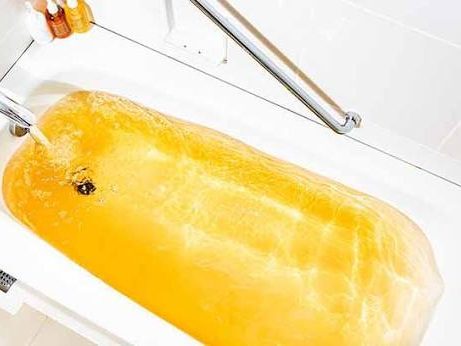
| 1. Hotel Hanshin Osaka Best for Everyday Soaking Rating: ⭐⭐⭐⭐ Location: 2-minute walk from JR Fukushima Station; 10-minute walk to Umeda Guest Reviews: Hot spring water in the room tub, spacious rooms for Japan, excellent buffet breakfast, smooth airport access via Loop Line Best Room: Superior Double Non-Smoking Price: From USD $95 – $160 per night |
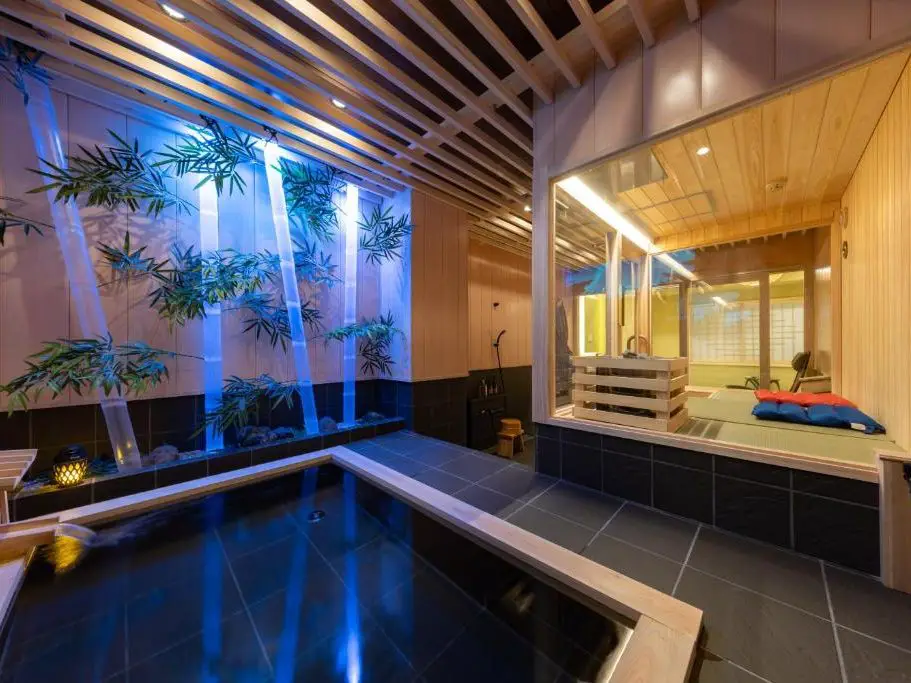
| 2. TAKENOYA Most Intimate Ryokan Experience Rating: ⭐⭐⭐ Location: 3-minute walk to Dotonbori; 5-minute walk to Nippombashi Station Guest Reviews: Spotless throughout, private bath and sauna on every floor, well-stocked minibar, staff attentive to every detail Best Room: 4F Gin-no-ma Price: From USD $580 – $750 per night |
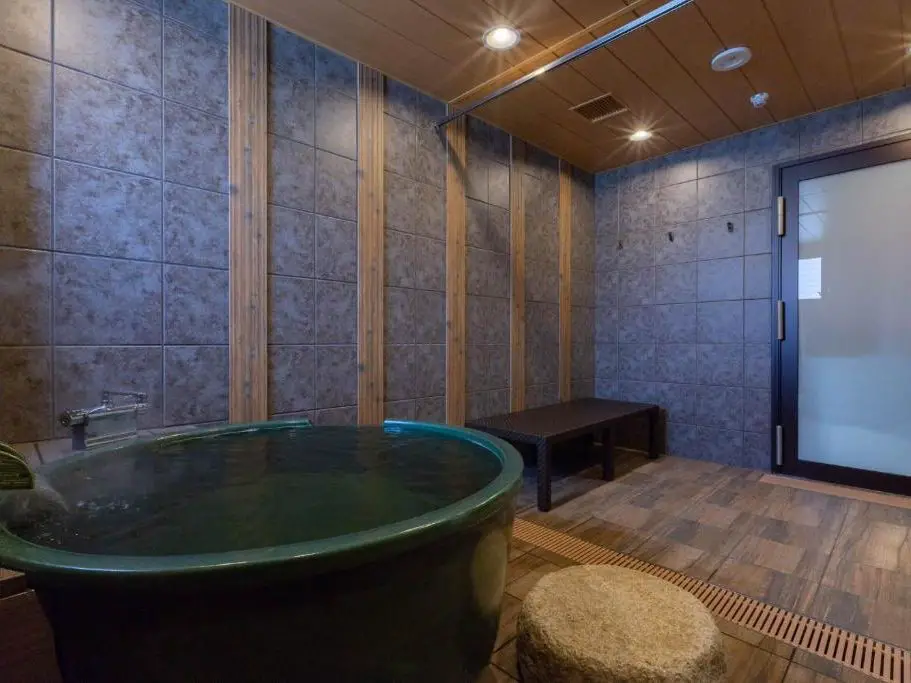
| 3. Hot Spring Osaka Hinode Hotel Nipponbashi Best for Tattoo-Friendly Private Bathing Rating: ⭐⭐⭐⭐ Location: 1-minute walk to Ebisucho Station; 10-minute walk to Dotonbori Guest Reviews: Deep seawater hot spring, complimentary evening drinks and ramen, spacious rooms by Osaka standards, helpful multilingual staff Best Room: Suite with Complimentary Lobby Drinks Price: From USD $110 – $165 per night |
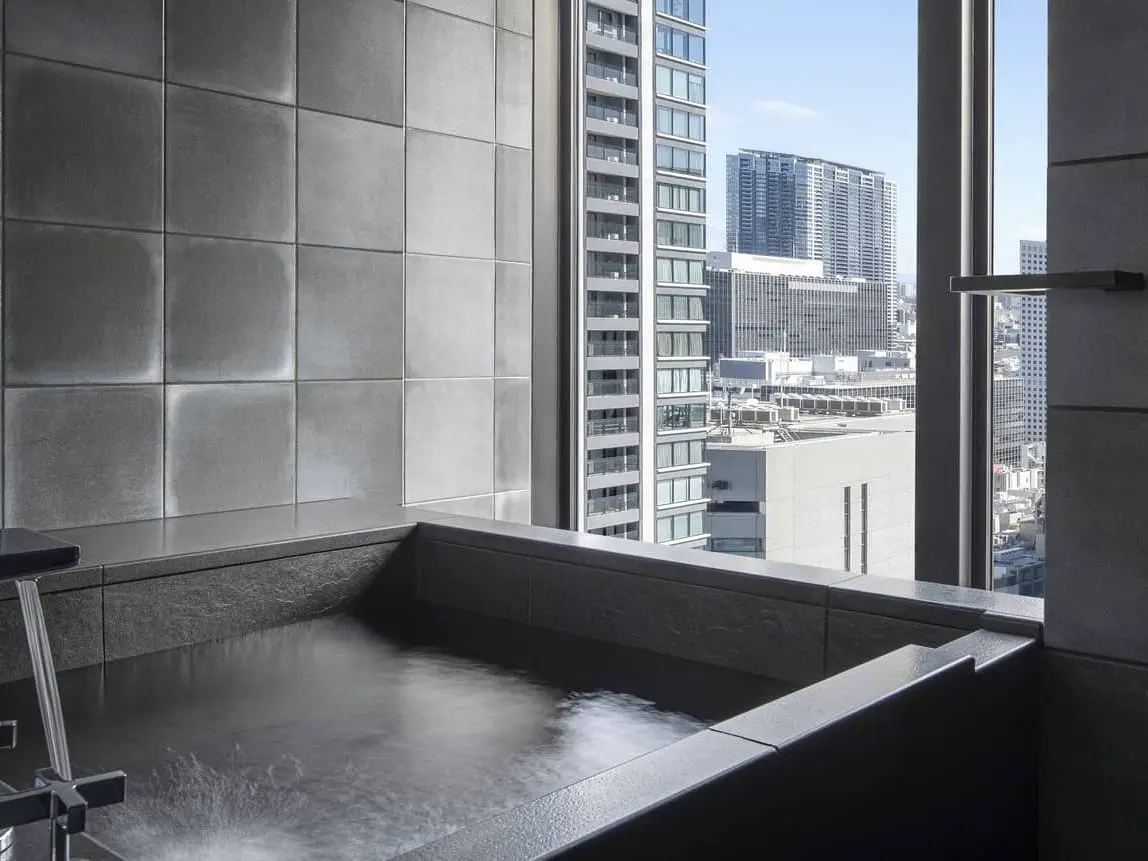
| 4. Four Seasons Hotel Osaka Most Luxurious Private Bath Rating: ⭐⭐⭐⭐⭐ Location: 7-minute walk to Osaka Station; 5-minute walk to Herbis Plaza Guest Reviews: Private ofuro bath used daily by guests, exceptional concierge service, tatami floor rooms with city views, pool and spa floors among the best in Osaka Best Room: Tatami Suites Price: From USD $430 – $700 per night |
Konjakuso Private Onsen Homes
These are whole-property rentals — no front desk, smart lock entry, fully private — each with its own outdoor bath. One group per booking, no shared facilities.
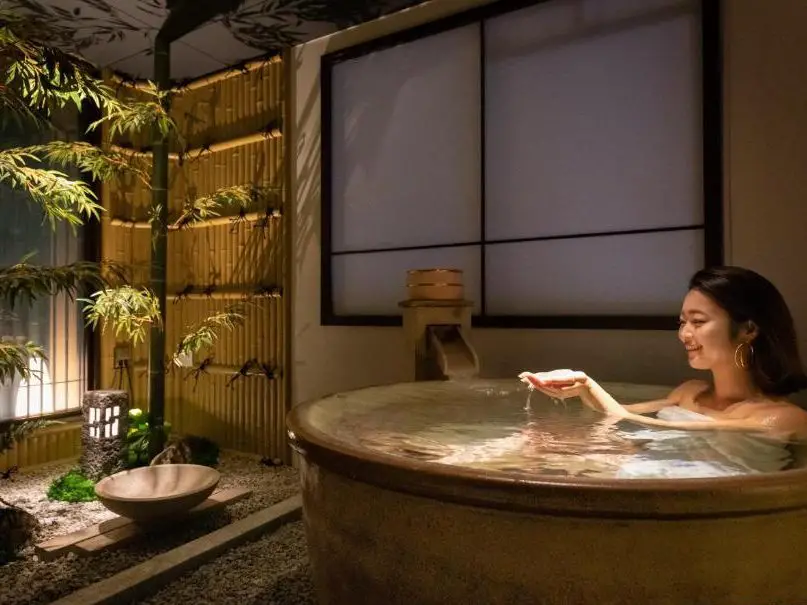
| 5. Konjakuso Dotonbori “Shoshi/Gōyakuya” SPA Stay Location: 5-minute walk to Dotonbori; 4-minute walk to Nippombashi Station Sleeps: Up to 8 (two floors bookable separately or together) Private Bath: Outdoor rotenburo on the terrace (Gōyakuya, 5F); semi-open air bath (Shoshi, 4F) Highlights: Edo-period pharmacy concept with sunken kotatsu dining, free stocked minibar including alcohol, Nintendo Switch, bamboo garden terrace Price: From USD $370 – $620 per night (whole floor) |
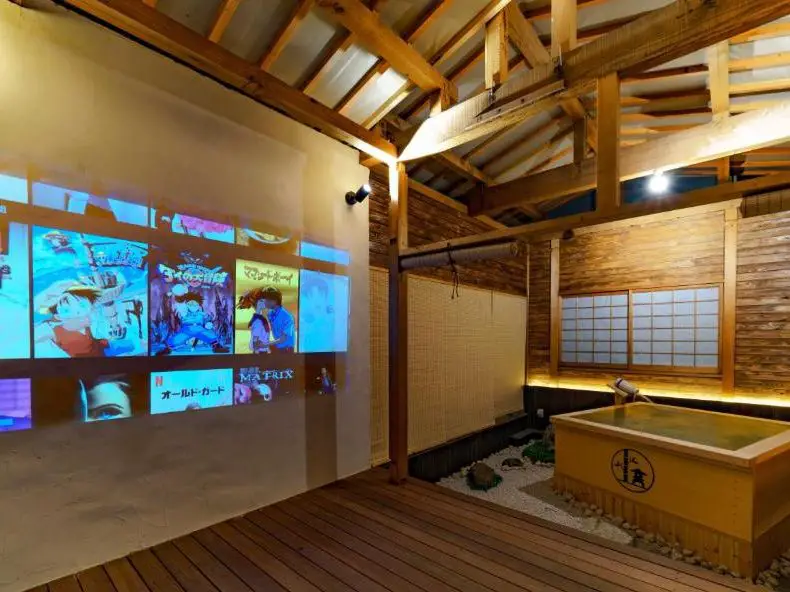
| 6. Konjakuso Shinsaibashi “Tarukaisen” Rooftop SPA Location: 2-minute walk to Nagahoribashi Station; 8-minute walk to Dotonbori Sleeps: Up to 14 Private Bath: Rooftop open-air hinoki cypress bath shaped like a sake barrel, with post-bath lounge area Highlights: Inspired by Edo-era sake transport boats, 140m² across three floors, home theatre projector, free sake and minibar, largest capacity of all Konjakuso properties Price: From USD $1,200 – $2,000 per night (whole property) |
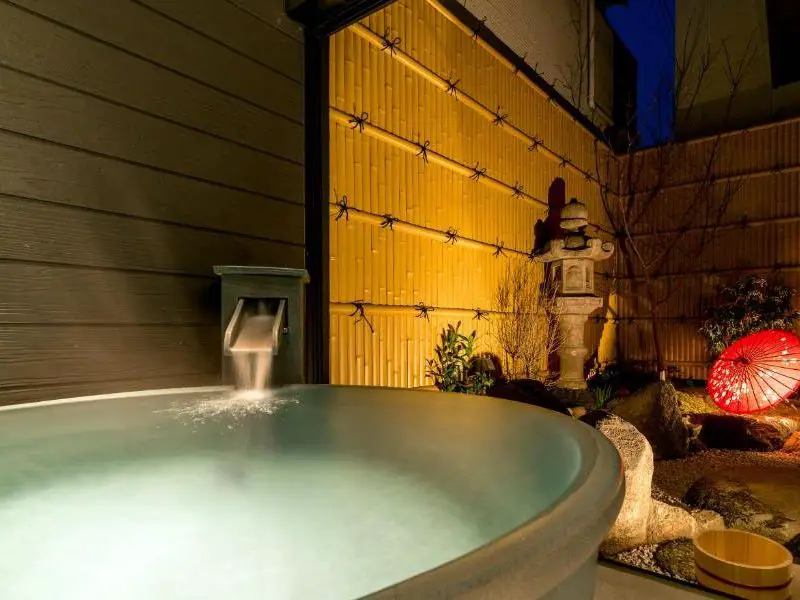
| 7. Konjakuso Tsuruhashi “Kakuju” Location: 5-minute walk to Tsuruhashi Station; 10 minutes by train to Namba Sleeps: Up to 14 Private Bath: Semi-open air bath set within a Japanese garden with crane motifs throughout Highlights: 160m² standalone house, four bedrooms, complimentary local sake and wine, Nintendo Switch and projector, quieter residential neighbourhood with easy JR Loop Line access Price: From USD $800 – $1,200 per night (whole property) |
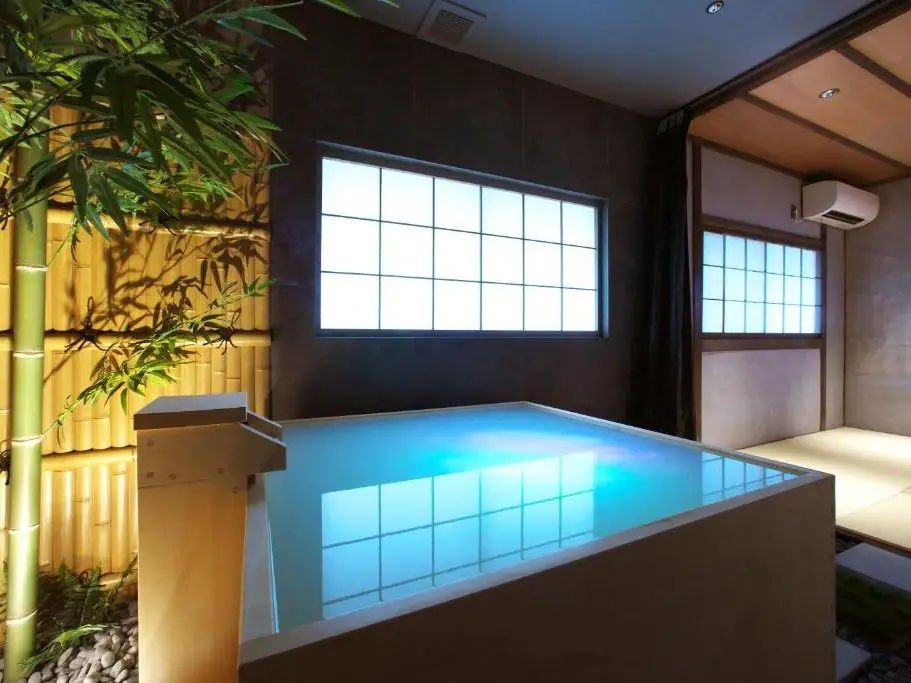
| 8. Konjakuso Bentencho “Hikariyuya” Location: 3-minute walk to Bentencho Station; 15 minutes by subway to Dotonbori Sleeps: Up to 9 Private Bath: Semi-open air hinoki cypress bath with projection mapping — animated fish and fireworks appear across the water’s surface at night Highlights: 80m² two-floor villa, four bedrooms, home theatre, fully equipped kitchen, river deity design concept with dry landscape garden flooring Price: From USD $800 – $2,500 per night (whole property) |
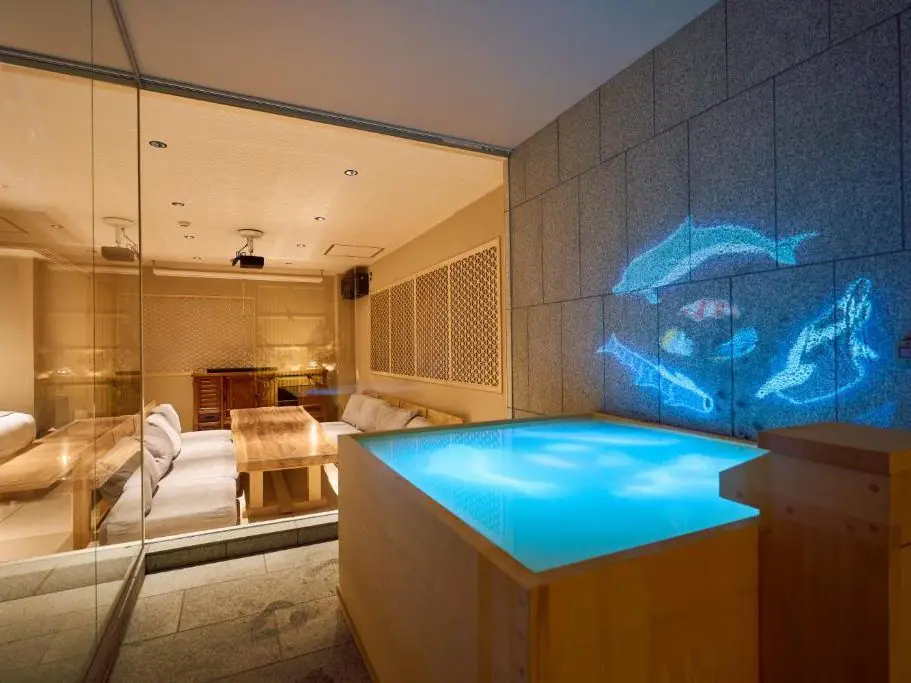
| 9. Konjakuso Tempozan “Ikesu/Takadoro” Location: 2-minute walk to Tempozan Ferris Wheel; 15 minutes by subway to Dotonbori Sleeps: Up to 10 per unit (two units available) Private Bath: Open-air bath with projection mapping, set within a converted Edo-period port merchant building Highlights: Bay area location steps from Osaka Aquarium, merchant district history woven into the design, home theatre, fully equipped kitchen, free parking available Price: From USD $800 – $1,200 per night (whole property) |
The Best Public Onsen in Osaka
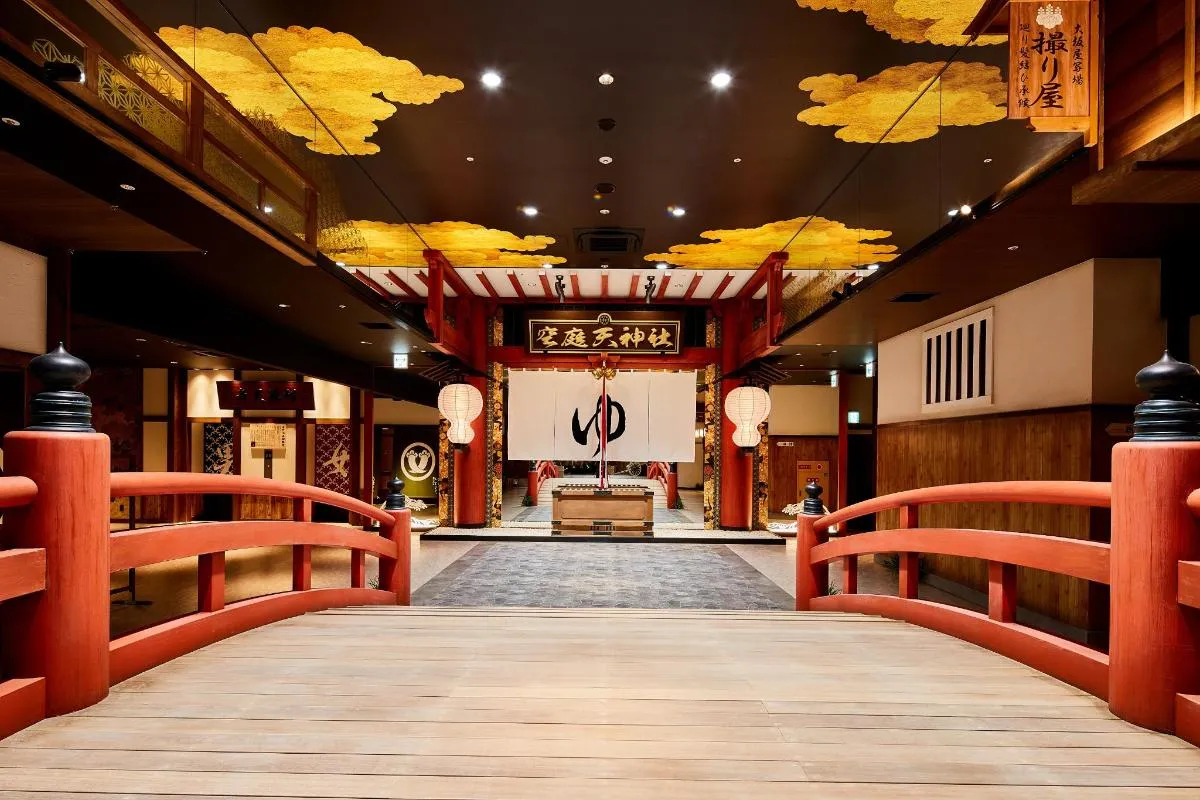
| If You Want the Full Onsen Experience Solaniwa Onsen, inside Osaka Bay Tower near Bentencho Station, is the best public onsen facility in the city — nine varieties of natural hot spring bath across indoor and outdoor settings, a rooftop garden with foot baths, sauna, bedrock bath, and an Azuchi-Momoyama period townscape running through the whole complex. Entry includes a yukata and towels, so you arrive empty-handed. Admission starts from around ¥2,310 for adults (roughly USD $15), with prices varying by day. Plan for two to three hours minimum. |
Why Private Onsen Is Hard to Find in Osaka
Osaka sits in a sedimentary basin rather than on volcanic bedrock, which means the city has no geothermal hot springs bubbling up naturally beneath it the way Hakone, Beppu, or Kinosaki do. The “onsen” water that does exist in Osaka is either piped in from outside the city, drawn from deep underground mineral aquifers, or — in some cases — simply heated municipal water marketed loosely as a spa facility. This matters because it shapes what is actually available.
- The geology problem — Japan’s 3,000-plus registered onsen resorts cluster around volcanic zones: Kyushu, the Japan Alps, the Izu Peninsula, and the mountains of Tohoku. Osaka, sitting in the Kinki basin between these zones, has no equivalent geothermal source. The mineral water at Hot Spring Osaka Hinode Hotel Nipponbashi is drawn from 750 metres below ground — a deep aquifer, not a volcanic spring. The hot spring water at Hotel Hanshin Osaka (Tokujiro no Yu) comes from a source over 1,000 metres underground. Both are legitimate mineral waters with documented compositions, but they are not onsen in the volcanic sense that most visitors picture.
- What this means practically — Osaka will never have the density of private onsen that Hakone or Kinosaki offer. The ryokans with in-room rotenburo fed by proper volcanic springs are in the mountains, not in the city center. Any article claiming eight or ten hotels with genuine private onsen in central Osaka is almost certainly counting public shared baths, day-use facilities, or properties where the “onsen” is a standard bathtub with mineral salts added. The list here is short because the genuinely qualifying options are short.
- The alternative that works — Where Osaka compensates is in its whole-property rental scene. The Konjakuso properties offer private outdoor baths in a format that has no equivalent in Hakone ryokans: you rent the entire building, the bath is yours for the full stay, and the price divided across a group of eight to fourteen people often undercuts a comparable ryokan per-person rate significantly.
What “Private Onsen” Actually Means Here
The phrase covers three meaningfully different experiences, and knowing which one you are booking avoids disappointment on arrival.
- In-room mineral water tap — At Hotel Hanshin Osaka, natural hot spring water flows from the bathroom tap of every room in the building. You fill the standard hotel bathtub yourself, let it cool to a comfortable temperature, and soak as often and as long as you want. There is no cedar tub, no rotenburo, no separate bath room — just a regular hotel bathroom with mineral water instead of municipal water. The advantage is total convenience: no booking, no time limit, available at 3am if you need it. The mineral composition (sodium-chloride type) gives the water a slightly silky texture, and guests consistently report softer skin after multi-night stays.
- Kashikiri private bath reservation — At Hot Spring Osaka Hinode Hotel Nipponbashi, the public onsen is separate from a set of 14 private bath rooms that guests reserve in advance by contacting the hotel directly. Each room is for your group only, for a fixed time block, at an additional fee on top of the room rate. The water is drawn from 750 metres underground and has a different mineral profile from the Hanshin water. This is the closest thing to a traditional kashikiri onsen experience available in central Osaka.
- Whole-property outdoor bath — The Konjakuso homes each come with an outdoor bath — hinoki cypress, rotenburo, or projection-mapped — that is yours for the entire duration of your stay. No time limits, no booking required, no other guests. The water in these baths is not mineral hot spring water; it is heated tap water in a private outdoor setting. The experience is private bathing in a well-designed outdoor tub, which is genuinely enjoyable and genuinely private, but distinct from a mineral onsen soak. TAKENOYA occupies a middle position — a private hinoki bath per floor, staffed like a ryokan, with the intimacy of a small property and none of the self-check-in logistics of the vacation homes.
If You Have Tattoos
Tattoo restrictions exist across Japan’s onsen culture because of longstanding associations between body art and organised crime — though policies are shifting, and private bathing sidesteps the issue almost entirely.
- Why private baths solve the tattoo problem — Public shared onsen in Osaka, including most hotel facilities, maintain no-tattoo policies. Private kashikiri baths and whole-property rentals operate differently: when no other guests share the facility, the restriction becomes irrelevant. Hot Spring Osaka Hinode Hotel Nipponbashi explicitly permits tattoos in its private bath rooms — this is confirmed policy, not a grey area. The Konjakuso properties are whole-building rentals with no shared facilities, so tattoo policies do not apply. TAKENOYA‘s private floor baths are similarly exclusive-use.
- Hotel Hanshin Osaka — The in-room tap is private by definition. Tattoo policy is not relevant when the bath is inside your own room. The public onsen and sauna on the premises, however, maintain standard restrictions.
- Four Seasons Hotel Osaka — The private ofuro on the 36th floor is booked exclusively per session, but as a hotel spa treatment room it does operate under the hotel’s own policies. Confirm directly with the spa team before booking if this is a concern.
- The one caution — Policy can change and varies by property manager. For the Konjakuso vacation homes in particular, confirm current policy at the time of booking rather than assuming. The general principle holds — private exclusive-use facilities have consistently more flexible policies than shared public baths — but contacting the property ahead of arrival takes thirty seconds and removes any ambiguity.
Best Time to Book
Osaka’s onsen properties are worth visiting year-round, but the experience of the outdoor baths at the Konjakuso homes changes significantly by season, and hotel rates follow a predictable pattern that rewards flexible travellers.
- Winter (December to February) — The best season for outdoor bathing by a significant margin. Temperatures drop to around 3–8°C in January and February, and the contrast between cold air and a steaming outdoor tub is the experience the Konjakuso rotenburo and hinoki baths are genuinely built for. Hotel rates across Osaka fall 20–25% below spring peak during this window (outside the Christmas and New Year period, which drives rates sharply up again from around December 23 to January 5). Mid-January through February is the sweet spot: cold enough for the outdoor bath to feel genuinely rewarding, quiet enough that Namba is walkable without crowds.
- Autumn (October to November) — The quieter second choice. Temperatures are mild (14–20°C), the Konjakuso outdoor baths are comfortable without being as dramatically contrasted as winter, and Osaka Castle’s surrounding trees turn in late November. Rates begin climbing again from mid-October as cherry-blossom-adjacent travel patterns shift demand. Book at least six to eight weeks ahead for the Konjakuso properties in November, as group travel peaks during this period.
- Spring (late March to early April) — Cherry blossom season drives Osaka’s highest hotel rates and tightest availability. The outdoor baths are pleasant in mild spring evenings, but prices for the Konjakuso properties reflect peak demand. If spring is the only option, book three to four months in advance and expect to pay 30–40% above the winter baseline.
- Summer (June to August) — The least suited season for outdoor onsen bathing. Osaka summers reach 34–36°C with high humidity, and soaking in a hot outdoor tub loses its appeal quickly. The in-room mineral water at Hotel Hanshin Osaka and the air-conditioned private ofuro at the Four Seasons Hotel Osaka remain comfortable year-round. The kashikiri baths at Hot Spring Osaka Hinode Hotel Nipponbashi are also fully indoor and climate-controlled.
Planning for Groups
The Konjakuso properties are the most practical private onsen option for groups in Japan’s major cities — a format that barely exists in Tokyo or Kyoto at this scale and price point.
- Cost per person — The math changes the value proposition significantly. Konjakuso Shinsaibashi “Tarukaisen,” which sleeps 14, runs from USD $1,200 per night for the whole property. Divided across 14 guests, that is roughly $86 per person per night — less than a bed in a shared dormitory at a Namba hostel during peak season, and considerably less than a room at a comparable hotel. For groups of eight or more, the whole-property rental format consistently undercuts the per-person cost of booking individual hotel rooms.
- Minimum stays and logistics — All Konjakuso properties require a minimum two-night stay. Check-in is via smart lock with a code sent ahead of arrival; there is no on-site reception. Arrange arrival time in advance with the host, and ensure every member of the group knows the code before the first person lands. The kitchens are fully equipped, which makes self-catering easy for larger groups and keeps daily costs lower than eating out for every meal.
- Choosing the right property for your group — For the most central location and easiest Dotonbori access, Konjakuso Dotonbori “Shoshi/Gōyakuya” is the call — two floors bookable separately or together, sleeping up to eight. For large groups of ten or more, Konjakuso Shinsaibashi “Tarukaisen” (sleeps 14, three floors, rooftop bath) and Konjakuso Tsuruhashi “Kakuju” (sleeps 14, standalone house, Japanese garden) are the two strongest options. Tsuruhashi suits groups who want a quieter residential neighbourhood; Shinsaibashi puts you closer to the action with a subway station two minutes from the front door.
- Booking lead time — The Konjakuso properties are popular with multi-family groups and corporate retreats, and the two-unit properties (Dotonbori and Shinsaibashi) book out three to four months ahead during peak season. For cherry blossom or Golden Week travel, six months is not excessive. For winter travel, eight to ten weeks is usually sufficient.
How to Book a Kashikiri Private Bath
The private bath rooms at Hot Spring Osaka Hinode Hotel Nipponbashi are the only traditional kashikiri onsen experience in central Osaka, and they require a separate reservation from the room booking.
- Step one: book the room first — The private baths are available to hotel guests only. Secure your room via your preferred platform before contacting the hotel about the private bath.
- Step two: contact the hotel directly — The kashikiri baths cannot be reserved through the room booking platform. Contact the hotel by email or phone at least 48 hours before arrival — ideally at the time of booking — and request a private bath time slot. The hotel’s confirmation email includes contact details.
- Step three: specify the bath type — The hotel has 14 private rooms with different bath configurations. The ceramic pot bath (tsubo-yu) is the most distinctive and worth requesting specifically if it is available for your dates. Mention your group size to be matched to an appropriate room.
- Step four: confirm the additional fee — The kashikiri bath is charged separately from the room rate. Confirm the current per-session fee at the time of booking — fees can change seasonally and are not always published on third-party platforms.
- On the day — Sessions are time-limited. Arrive a few minutes early, shower before entering the bath (this is standard onsen etiquette regardless of whether the facility is private), and make the most of the full session. The mineral water here is a deep seawater type drawn from 750 metres underground — different from the sodium-chloride spring at Hotel Hanshin, with a higher iron content that gives the water a slightly darker colour.
FAQs
1. Does Osaka have natural onsen?
Osaka does not sit on volcanic bedrock, so it has no geothermal hot springs in the traditional sense. Several hotels draw mineral water from deep underground aquifers — up to 1,000 metres below the surface — which qualifies legally and chemically as onsen water in Japan, but the source is a sedimentary mineral aquifer rather than volcanic activity.
2. Can I use a private onsen in Osaka if I have tattoos?
Private and exclusive-use baths are generally the safest option. The private kashikiri baths at Hot Spring Osaka Hinode Hotel Nipponbashi explicitly permit tattoos. Whole-property Konjakuso rentals have no shared facilities, so standard restrictions do not apply. Confirm directly with any property before arrival if this is a concern.
3. What is the difference between a kashikiri onsen and a private onsen room?
A kashikiri bath is a shared facility reserved exclusively for one group during a fixed time block — you book a time slot, use the bath, and the room is cleaned for the next group. A private onsen room is a bath attached permanently to your accommodation, available whenever you want with no time limit. Both offer privacy; the key difference is time access and cost structure.
4. How far in advance do I need to book the Konjakuso properties?
For cherry blossom season (late March to April) and Golden Week (late April to early May), book four to six months ahead. For autumn (October to November), six to eight weeks is usually sufficient for mid-week stays, but weekends book faster. For winter travel outside the Christmas and New Year period, eight weeks is generally enough.
5. Is the outdoor bath at the Konjakuso properties heated mineral water?
The outdoor baths at the Konjakuso properties — rotenburo, hinoki, and projection-mapped baths — are heated tap water, not mineral hot spring water. The private experience and the bath design are the draw, not the mineral content of the water. If mineral water is important to you, Hotel Hanshin Osaka and Hot Spring Osaka Hinode Hotel Nipponbashi are the properties to prioritise.
6. What is the best Osaka onsen hotel for couples?
TAKENOYA is the strongest option for two people — three suites maximum, private hinoki bath per floor, 24-hour staff, and breakfast included. It has the intimacy and service level of a small ryokan without the self-check-in logistics of the vacation home rentals. Hotel Hanshin Osaka is the best-value option for couples who want mineral water in a private bath without a premium price.
7. Can you visit Osaka for a day trip to use a private onsen?
The kashikiri baths at Hot Spring Osaka Hinode Hotel Nipponbashi are available to hotel guests only and require an overnight stay. Solaniwa Onsen at Osaka Bay Tower offers private open-air bath rooms bookable by day visitors for 90-minute sessions — this is the most accessible private bathing option for visitors not staying overnight.
8. Is it worth going to Arima Onsen as a day trip from Osaka instead?
Arima Onsen, about 40 minutes from Osaka Station by direct bus, is one of Japan’s oldest onsen towns and offers volcanic spring water in both gold (iron-rich, reddish) and silver (carbon dioxide) varieties — a genuinely different water quality from anything available in central Osaka. For visitors who want a traditional onsen town experience with historic ryokans and multiple public bathhouses, a day trip or overnight stay in Arima is worth considering alongside the city options.