
Mexico City runs at a pace that gets under your skin fast — the museums, the markets, the food, the sheer scale of it. Coming back to a private hot tub in your room at the end of all that isn’t a luxury, it’s a practical decision. The city sits at 2,200 metres above sea level, and a long soak does more for tired legs here than it would anywhere else. These hotels have the real thing — a tub in your room or on your balcony, not a shared spa pool two floors down.
Table of Contents
Mexico City Hotels

| 1. Hotel Novit Rating: ⭐⭐⭐⭐ Location: 3-min walk to World Trade Center Guest Reviews: Rooftop pool city views, Aktuel restaurant, spacious suites with kitchenette, in-room hydromassage bath Best Room: King Suite Price: From USD $115 – $220 per night |

| 2. KALI Escandón Mexico City Best for Couples Rating: ⭐⭐⭐⭐ Location: 18-min walk to La Condesa Guest Reviews: Junior Suite jacuzzi spacious and quiet, Mercado Escandón across the street, buffet breakfast included Best Room: Presidential Suite Price: From USD $95 – $230 per night |

| 3. MC Suites Mexico City Rating: ⭐⭐⭐⭐⭐ Location: 17-min walk to Angel of Independence Guest Reviews: Spacious jacuzzi shower configuration, kitchenette with microwave and minibar, walkable to museums Best Room: King Suite Price: From USD $90 – $165 per night |

| 4. Hotel Punto MX Best Location Rating: ⭐⭐⭐⭐ Location: 6-min walk to Zócalo Square Guest Reviews: Spa bath with bubble bath supplies, pillow menu, San Juan Market 600 metres away Best Room: Queen Suite with Spa Bath Price: From USD $80 – $180 per night |
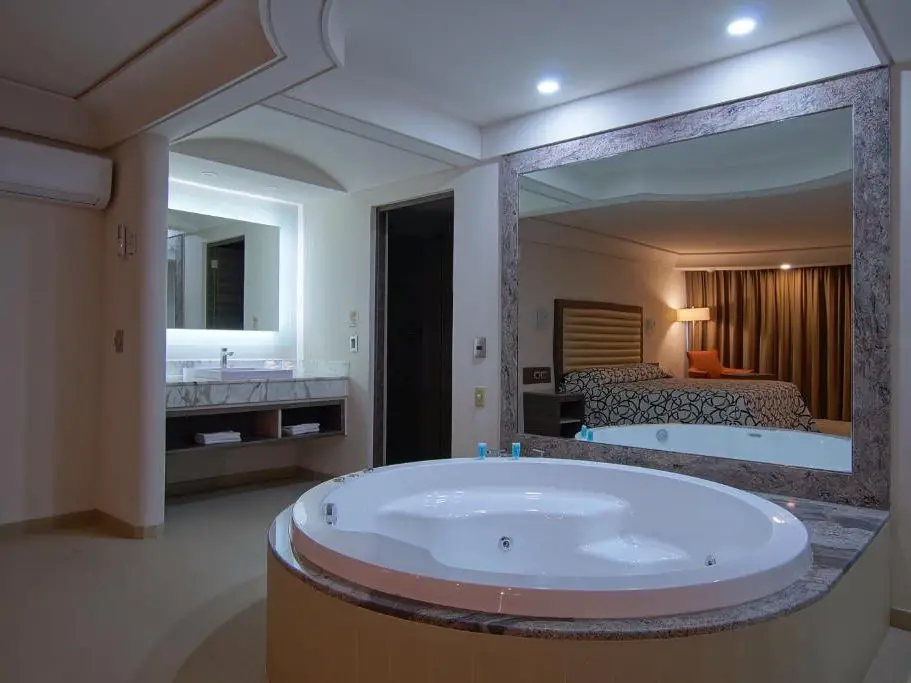
| 5. Econo Express Hotel Rating: ⭐⭐⭐ Location: 15-min drive to Palacio de Bellas Artes; steps from Nativitas metro Guest Reviews: Free buffet breakfast included, circular spa tub with walled mirror, Nativitas metro steps away Best Room: Deluxe Suite with Spa Bath Price: From USD $55 – $130 per night |

| 6. Hilton Mexico City Reforma Best View Rating: ⭐⭐⭐⭐⭐ Location: 10-min walk to Palacio de Bellas Artes Guest Reviews: Corner suite jacuzzi with Alameda views, El Cardenal restaurant in lobby, rooftop lap pool Best Room: King Master Suite Price: From USD $150 – $450 per night |

| 7. Camino Real Polanco Mexico Most Luxurious Hotel Rating: ⭐⭐⭐⭐⭐ Location: 12-min walk to National Museum of Anthropology Guest Reviews: Heated 37°C outdoor pool, Morimoto restaurant on site, whirlpool tubs in upgraded suites Best Room: Master Suite Price: From USD $140 – $375 per night |

| 8. Hotel Astor Rating: ⭐⭐⭐⭐ Location: 10-min walk to Monument to the Revolution Guest Reviews: Corner spa bath, soundproof windows, La Casa de los Trompos taquería across the street Best Room: King Room with Spa Bath Price: From USD $60 – $130 per night |

| 9. Exe Cities Reforma Rating: ⭐⭐⭐⭐ Location: 12-min walk to Angel of Independence Guest Reviews: Marble bathrooms with hydromassage tub in every room, sauna on site, Sevilla metro nearby Best Room: Superior Double Room with Jacuzzi Price: From USD $55 – $150 per night |

| 10. We Hotel Aeropuerto Rating: ⭐⭐⭐⭐ Location: 5-min drive to Benito Juárez Airport; free 24hr shuttle Guest Reviews: Master Suite his-and-hers jacuzzi and shower, Mexico Mi Amor restaurant, free airport shuttle every 15 minutes Best Room: Master Suite Price: From USD $100 – $220 per night |

| 11. Hotel Astor Best Value Rating: ⭐⭐⭐⭐ Location: 10-min walk to Monument to the Revolution Guest Reviews: Corner spa bath, soundproof windows, La Casa de los Trompos taquería across the street Best Room: King Room with Spa Bath Price: From USD $60 – $130 per night |
Mexico City has a hotel supply problem that most travel sites quietly ignore. When a listing says “hot tub,” it could mean a private jetted tub in your bathroom, a jacuzzi on your suite terrace, a tub in a shared hotel spa open to all guests, or a communal pool area with jets at one end. These are four completely different things, and OTA filter pages treat them as one.
The distinction matters more in CDMX than in most cities because the hotel stock is unusually mixed. Properties like Exe Cities Reforma have hydromassage tubs in every bathroom as a standard feature. Properties like the Hilton Mexico City Reforma have a shared spa hot tub accessible to all guests plus a separate in-room jacuzzi available only in the Master Suite. Properties like Hotel Novit have a rooftop shared jacuzzi alongside select suites with in-room hydromassage. Booking “a hotel with a hot tub” and assuming you’ll have a private tub in your room is a reliable way to be disappointed.
How to confirm what you’re actually getting:
- Read the specific room description, not the property overview. The property overview lists all amenities anywhere on site. The room description lists what’s actually in your room. If the room description doesn’t mention a tub, jacuzzi, or spa bath, you won’t have one privately.
- Look for these terms in room listings: spa bath, hydromassage bath, jacuzzi, jetted tub, whirlpool. “Hot tub” on its own often refers to shared facilities. “Spa bath” in a room description almost always means a private in-room tub.
- Check the room photos. A private in-room tub is a selling point hotels photograph heavily. If you can’t find a photo of a tub inside a bedroom or bathroom, treat that as a red flag.
- Confirm directly if it matters. A quick message to the property asking “does Room Type X have a private hot tub inside the room?” takes two minutes and eliminates all ambiguity. Front desks in CDMX hotels are generally responsive to this question.
- Select the room type explicitly. Most hotels on this page offer jacuzzi rooms as a specific bookable category — not as a standard room feature. If you book a standard double and hope for a tub, you won’t get one. The jacuzzi room must be selected at the time of booking.
- Watch for terminology differences. Some hotels list the in-room tub as a “spa bath,” which in Mexican hotel terminology typically means a jetted soaking tub rather than a plain bathtub. Same product, different label — worth knowing when searching room listings.
Is the Upgrade Worth It?
A standard room at most hotels on this page runs $60–$150 per night. The jacuzzi room at the same property typically adds $30–$80 on top of that. Whether that gap is worth closing depends less on personal preference than it does on how you’re actually using Mexico City. A few things that tip the calculation:
- The altitude is real and cumulative. CDMX sits at 2,200 metres above sea level. Most visitors don’t feel it sharply on day one, but by day two or three — after full days of walking museums, markets, and neighbourhoods — leg fatigue sets in faster than it would at sea level. A hot soak accelerates muscle recovery in a way that a standard shower doesn’t. If your itinerary involves Teotihuacán, Chapultepec, the Historic Centre, and Xochimilco across four or five days, the tub earns its keep.
- The rainy season makes outdoor options less reliable. From May through October, Mexico City gets heavy afternoon and evening downpours, often lasting two to three hours. Rooftop pools, hotel terraces, and outdoor bars become unreliable in the evenings precisely when you’d want them. An in-room tub fills that gap cleanly.
- Room size matters here. Jacuzzi rooms in CDMX hotels tend to be significantly larger than standard rooms at the same property — not just a tub added to an otherwise identical space. At MC Suites and Hotel Novit, for example, the suite categories with in-room tubs also include separate living areas and kitchenettes. The tub is often the smallest reason to upgrade.
- Shared spa access is not the same substitute it is elsewhere. Several hotels on this page have shared spa facilities, but shared spa hours in Mexican hotels are typically limited — often 7am to 9pm — and availability isn’t guaranteed. An in-room tub is available at midnight after a late dinner in Roma Norte. The shared spa is not.
The upgrade is harder to justify for one-night stays or airport layovers, where the tub becomes a single-use amenity. For stays of three nights or more, the cost per night becomes small relative to the daily recovery benefit, and most guests who book the jacuzzi room report wishing they’d done it for the whole trip rather than just part of it.
Which Part of the City Suits Your Trip
Mexico City is enormous — around 20 million people spread across an area bigger than many small countries — and the neighbourhoods where these hotels sit are genuinely different in character, convenience, and feel. Where you stay shapes the trip more than in most cities.
- Historic Centre (Centro Histórico) — This is the oldest part of the city, built on the ruins of the Aztec capital Tenochtitlán. The Zócalo, Templo Mayor, Palacio de Bellas Artes, and dozens of colonial churches are all within walking distance. Hotel Punto MX sits here, which makes it the strongest choice if museums, markets, and pre-Hispanic history are the core of your trip. The tradeoff is that Centro can feel overwhelming — it’s dense, loud during the day, and some surrounding streets are rougher after dark. It’s safe and well-policed around the main plazas, but it rewards situational awareness more than the neighbourhoods further west.
- Reforma Corridor — Paseo de la Reforma is the city’s grand central boulevard, lined with monuments, embassies, and high-rises. Staying here puts you equidistant from Centro to the east and Polanco and Chapultepec to the west. Hilton Mexico City Reforma, Exe Cities Reforma, and Hotel Astor all sit in or just off this corridor. It’s the most practical base for first-time visitors who want flexibility — everything is reachable from here without committing to one neighbourhood’s character. The area around Reforma itself is polished and safe; two or three blocks off the main boulevard in certain directions it becomes more mixed.
- Polanco — Mexico City’s wealthiest residential and commercial district, with luxury shopping on Presidente Masaryk, a high concentration of Michelin-recognised restaurants, and Chapultepec Park on its doorstep. Camino Real Polanco sits here. It’s the easiest neighbourhood to navigate, the safest for first-time visitors, and the most expensive for food and drink outside the hotel. If the National Museum of Anthropology, Chapultepec Castle, or Soumaya Museum are priorities, Polanco is the natural base.
- Napoles and Benito Juárez — A mid-city business district that most tourists skip, sitting between the Reforma corridor and the airport. Hotel Novit is here. It’s not a neighbourhood you’d choose for its character — there’s no particular draw to the streets around it — but the WTC convention centre next door and the reasonable Uber distances to most attractions make it a solid choice for business travellers or anyone prioritising price over location. Insurgentes metro line runs through it and connects quickly to most of the city.
- Escandón — A quieter residential neighbourhood just west of Roma, increasingly popular with Mexico City regulars who’ve tired of the tourist circuit. KALI Escandón sits here. Mercado Escandón is directly across the street, La Condesa is an 18-minute walk, and the neighbourhood has a genuinely local feel — good taquerias, corner shops, low foot traffic. For a first-time visitor it requires a bit more initiative to get oriented, but for anyone returning to the city or wanting to avoid the standard tourist experience, it’s a strong base.
- Airport Area — We Hotel Aeropuerto is the obvious choice for late arrivals, early departures, or transit stays. It’s not a neighbourhood in any meaningful tourist sense — you’re in an industrial pocket of the city with little reason to venture out. The free 15-minute shuttle makes it logistically clean, but don’t plan a sightseeing trip from here without accepting that everything requires an Uber.
- Colonia Obrera — A working-class neighbourhood south of Centro where Hotel Escala Siglo XXI sits. Chabacano metro is 700 metres away and connects well to the rest of the city. The neighbourhood has a rough reputation in older travel guides but has gentrified gradually and is functional for budget travellers comfortable navigating Mexican cities independently. Not the right base for first-time visitors wanting a curated experience; very much the right base for anyone prioritising value and happy to use the metro.
Polanco and the Reforma corridor are the easiest choices for first-timers. Centro is the most immersive but least relaxed. Escandón, Napoles, and Obrera reward travellers who know what they’re getting into and are choosing value or local character over convenience.
When to Book and What It Costs
Mexico City doesn’t have a bad time to visit, but it does have a cheaper time and a more comfortable time, and they’re not always the same month.
- November to April is the dry season and the most popular window for international visitors. Days are clear, temperatures sit between 18°C and 24°C, and there’s almost no rain. Hotels know this — rates across the city are higher from late November through March, and jacuzzi room categories in particular sell out well ahead of standard rooms because the pool of people booking them is smaller and more deliberate. If you’re visiting in this window, book the specific room type you want at least three to four weeks out. At properties like KALI Escandón and Hotel Punto MX, the jacuzzi suite is a single room category with limited inventory — waiting until a week before arrival is a reliable way to find it gone.
- May through October is the rainy season, with the heaviest rainfall in June, July, and August. Afternoons and evenings bring regular downpours, sometimes heavy. Hotel rates drop noticeably, often 20–35% below dry season pricing, and availability for jacuzzi rooms is far more flexible. This is the best window for value, and as noted in the previous section, the rain actually strengthens the case for an in-room tub since outdoor hotel facilities become less reliable in the evenings.
- The shoulder months of October and April sit between the two seasons in both weather and price. October is technically rainy season but the rain lightens significantly by mid-month. April is dry but hotel rates haven’t fully climbed to peak levels yet. Both months represent a reasonable balance of cost and conditions.
- Jacuzzi rooms need to be booked as a specific category. This is worth repeating in a booking context. Most properties don’t automatically allocate a tub room when you book a standard or superior room and hope for an upgrade. The jacuzzi room is a distinct room type that must be selected explicitly at the point of booking. At several hotels on this page — particularly Hotel Escala Siglo XXI, Hotel Astor, and Hotel Punto MX — the tub rooms represent a small fraction of total inventory. Booking the wrong category and requesting an upgrade at check-in works occasionally, but it’s not a strategy worth depending on.
- Price ranges shift significantly by area. Polanco and Reforma corridor hotels command a premium year-round. The same quality of in-room jacuzzi experience costs roughly 40–60% less in Escandón, Napoles, or Obrera than it does in Polanco. If the neighbourhood itself isn’t the draw, that gap is worth considering.
- Long weekends and public holidays in Mexico push rates up sharply. Mexican public holidays include dates in September (Independence Day celebrations, which are centred on the Zócalo and generate city-wide demand), November (Day of the Dead), and December. The Zócalo and Centro hotels in particular see significant rate spikes around these dates. If your trip overlaps with any of these periods, book earlier than you otherwise would.
FAQs
1. Do I need to book a specific room type to get a private hot tub, or will any room at these hotels do?
A specific room category must be selected at the point of booking — the jacuzzi room won’t be allocated automatically if you book a standard or superior room. Most hotels on this page list the tub room as a distinct category with its own name, such as King Suite, Superior Room with Jacuzzi, or Deluxe Suite with Spa Bath. Book the wrong type and requesting an upgrade at check-in is unreliable.
2. Which Mexico City hotel has a hot tub on a private terrace rather than inside the bathroom?
KALI Escandón Mexico City is the standout option for an outdoor private tub — the Presidential Suite has a terrace jacuzzi with city views. The Hilton Mexico City Reforma’s Master Suite also has a jacuzzi positioned against a corner floor-to-ceiling window, which gives a similar feel of soaking with the city visible around you, though technically indoors.
3. Does Mexico City’s altitude change how a hot tub feels?
The altitude at 2,200 metres means physical fatigue accumulates faster than at sea level, particularly after full days of walking across a city where distances between attractions are significant. The physiological effect of a hot soak on muscle recovery is the same as anywhere, but the need for it is more pronounced — most visitors who spend three or more days sightseeing in CDMX notice the difference by day two.
4. Is there a hotel with a private hot tub in the room close to the Zócalo and the Historic Centre?
Hotel Punto MX is the strongest option, sitting a 6-minute walk from Zócalo Square with a confirmed in-room jacuzzi in the King Room with Jacuzzi category. It’s the only hotel on this page that puts you squarely in the historic centre with a private tub, which makes it useful if Templo Mayor, Palacio de Bellas Artes, and the colonial streets are the core of your trip.
5. How far ahead should I book a jacuzzi room in Mexico City?
During the dry season from November through April, three to four weeks is the minimum for the specific room type you want — jacuzzi rooms represent a small fraction of total inventory at most properties and sell before standard rooms do. During rainy season from May through October, availability is far more flexible and last-minute bookings are generally possible, though rates are less predictable.
6. What is the cheapest hotel in Mexico City with a genuine private hot tub in the room?
Hotel Escala Siglo XXI has the lowest confirmed floor rate on this page, with select superior rooms featuring a large circular jacuzzi starting from around $35 per night. Econo Express Hotel is the next most affordable option, with a Deluxe Suite with Spa Bath from around $55. Both are in residential areas away from the main tourist corridors, which is a significant part of why the rates are low.
7. Are there hotels with private hot tubs near Mexico City’s international airport?
We Hotel Aeropuerto sits 1.1 miles from Benito Juárez International Airport and runs a free shuttle every 15 minutes around the clock. The Master Suite has a confirmed in-room jacuzzi with his-and-hers sinks and shower, making it the most practical option for a layover or early departure stay where you also want an in-room tub.
8. Do Mexico City hotels charge extra to use the in-room hot tub, or is it included in the room rate?
At every hotel on this page, the in-room tub is included in the room rate with no separate usage charge — it’s a room feature, not a paid facility. The only additional cost associated with the tub is the premium you pay for the jacuzzi room category over a standard room at the same property, which is factored in at the time of booking.